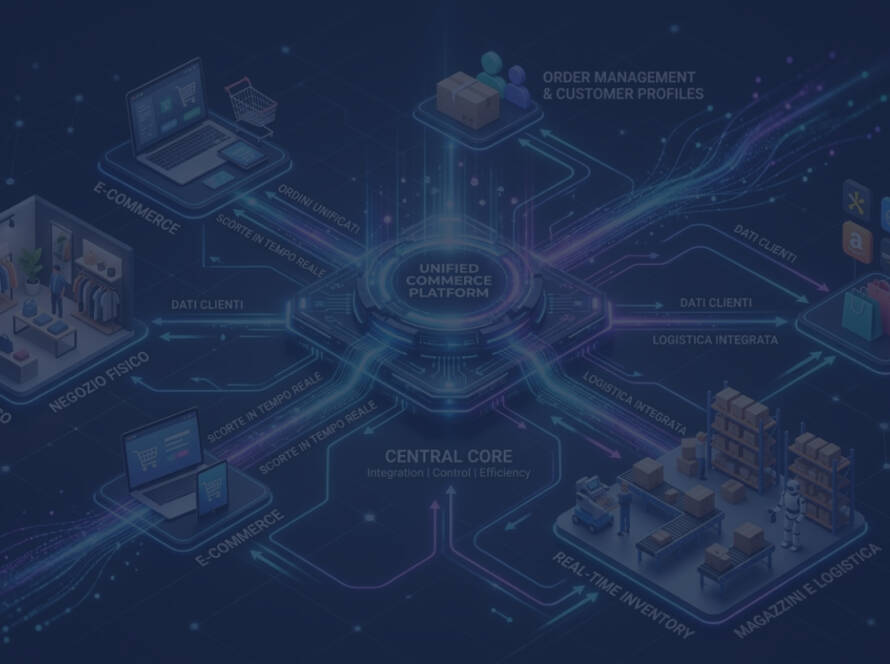
Expanding a fashion brand today is easier than ever. Marketplaces, e-commerce, and retail channels allow you to enter new markets rapidly.
The real problem arrives later.
Imagine this scenario:
You have just launched on a new international marketplace.
Sales take off.
Numbers grow. The team celebrates. Then, the peak sales season hits. In three days, orders double. The warehouse goes into overdrive. Shipments back up. Customers start writing. The stock listed on the website does not match actual inventory. Returns pour in, and you cannot process them.
This is not an extreme case.
It is exactly what happens when a brand grows faster than its logistics infrastructure. And it almost always happens at the worst possible moment: right when you need to improve the customer experience most.
Logistics does not stop working gradually. It collapses. And it always does so at the wrong time.
The Economic Impact: The Real Cost is Strategic, Not Operational
Many brands view these issues merely as operational inefficiencies. In reality, their impact runs much deeper.
The most common hidden costs include:
Products physically present but not in inventory → Direct loss of revenue.
Picking errors → Increased returns + management costs + loss of reputation.
Unmanaged returns → Tied-up capital representing up to 20% to 30% of stock.
Long fulfillment times → Decline in customer experience.
A Concrete Example
A fashion brand that scales from 1,000 to 10,000 orders per month without adapting its logistics can expect to:
Increase errors by up to 3% to 5% of total orders.
Lose up to 10% to 15% of potential sales during peak periods.
The result? It is not just inefficiency. It is growth that fails to be captured.
The 4 Most Common Mistakes in Omnichannel Expansion
1. Replicating the domestic logistics model in new markets
This is one of the most frequent missteps. At first, it seems like the simplest solution: same processes, same structure, same operational approach. However, what works on a local scale rarely withstands international complexity. The supply chain lengthens, the warehouse expands, costs rise, and the structure becomes too rigid just when flexibility is required.
2. Managing all flows the same way
In fashion, B2B and B2C coexist but operate on completely different logics: bulk, distributed orders on one side; single-item, high-frequency orders on the other. Treating them with the same operational processes inevitably leads to inefficiencies, errors, and warehouse congestion.
3. Underestimating returns
In the fashion sector, returns are not an exception to be handled after the fact; they are a structural component of the business. Ignoring their impact means locking up capital, slowing down the stock cycle, and compromising actual product availability.
4. Building omnichannel retail without synchronizing flows
This is one of the most underestimated errors. Developing omnichannel capabilities without real synchronization leads to systems that do not communicate, unaligned stock, and conflicting operational priorities.
The outcome is always the same:
Products sold but unavailable (overselling).
Shipment delays, carrier rescheduling, and exploding inbound/outbound areas.
An inconsistent customer experience across different channels.
It is precisely at this point that growth begins to slow down, often before the root issue becomes apparent to decision-makers.
Signs It Is Time to Change Your Model
There comes a point when growth stops being purely a positive sign and begins to strain the entire operation. This is a gradual process made up of small indicators that, if read correctly, clearly show the current model is no longer sustainable.
If you are experiencing one or more of these warning signs, you are already in a critical phase:
Volumes grow, but errors grow faster (processes are not scaling with the business).
Fulfillment times worsen during peak seasons.
The operations team works in a constant state of emergency, and workflows never stabilize.
Returns pile up without rapid restocking, blocking both inventory and liquidity.
International expansion slows down due to operational limits, not a lack of demand.
These signs should not be viewed as isolated problems, but as symptoms of a model that has reached its limit.
“This is the decision point.”
The issue is not that your brand is growing too fast. The issue is that the infrastructure that got you here was not designed to support the next phase. Continuing to force it usually means slowing down exactly when you should be accelerating.
The Solution: A 3PL Model Designed for Omnichannel Fashion Logistics
A specialized 3PL partner is not just an outsourced warehouse. It is a strategic asset that allows your brand to grow without operational friction, bringing expertise, technology, and processes that would require a disproportionate amount of resources to build internally.
What Changes Concretely:
Centralized stock governed by channel.
Dedicated flows for B2B and B2C.
Processes engineered for peak demand.
Structured returns management.
Total, real-time monitoring.
A highly competent dedicated contact capable of supporting the brand in technical-logistics decisions.
A Real Case Study from One of Our Clients
Before: Internal Management at the Limit
2 to 3 days to fulfill e-commerce orders during peaks.
Error rate around 4% of orders.
Returns reintegrated into stock in 7 to 10 days.
Frequently unaligned stock.
After: Structured 3PL Model
Same-day or next-day fulfillment, even during peak periods.
Error rate below 1%.
Returns inspected, reconditioned, and restocked within 48 hours.
Stock governed in real time across all channels.
This is the result of processes designed, not adapted, for this specific type of operation.
WMS: The Technology Making This Possible
In fashion, scalable logistics are impossible without a high-caliber Warehouse Management System (WMS). We are not talking about generic software adapted to the sector. We are talking about a proprietary platform developed over 30 years of fashion-specific operations, continuously improved based on the real-world challenges that emerge daily in our warehouses.
What This System Accomplishes:
Governs stock in real time across all channels within a single physical inventory.
Logically separates B2B and B2C flows (same infrastructure, different rules).
Guides every operation (picking, packing, labeling, and returns) through operational guardrails that make errors virtually nonexistent, keeping productivity aligned with top industry expectations without compromising quality or customer experience.
Integrates seamlessly with the market’s leading ERPs and e-commerce platforms.
Operates consistently across all branches in Europe, Asia, and America.
The result: fewer errors, greater speed, and total control, even when volumes explode.
Returns: The Critical Divide Between Those Who Grow and Those Who Stall
In the fashion sector, returns can exceed 30% of orders. This is not an abstract statistic; it is an operational variable that directly impacts profitability. Every garment that comes back and sits in an uninspected backlog for 7 to 10 days represents:
Blocked working capital.
Stock unavailable for new sales.
Margins eroded by management costs.
A highly sensitive point in the customer experience.
The correct model reverses this logic. The return is received, inspected, reconditioned, and reintegrated into stock, with priority given to processing the customer’s refund. Within 24 to 48 hours, it is ready for the next sale.
Why a Generalist 3PL Fails in Fashion Logistics
This is a difference that matters. A generalist operator adapts. They standardize processes and learn the specificities of your industry on your project, at your expense in terms of errors, delays, and lost time.
A specialized partner already understands the problem before you even describe it:
They know how to manage 50,000 to 60,000 SKUs for a single client.
They know how to operationally separate wholesale picking from individual e-commerce orders, distinguishing between flat pack, shoes, hanging garments, and accessories.
They know that luxury packaging is not the same as standard packaging.
They know that during promotional events, everything that worked smoothly for eight months will be put to the test in 72 hours.
This knowledge is not built during a six-month onboarding period. It is accumulated over thirty years of vertical operations in fashion and lifestyle logistics.
How We Design Logistics For You: Our Four-Phase Approach
We don’t start with the logistics. We start with your business model.
1. Assessment
Before making any proposal, we analyze your flows, channels, volumes, seasonality, and the bottlenecks you are currently facing, even those that seem normal but aren’t. The result is a precise snapshot of your current situation and hidden constraints.
2. Operational Model Design
Together, we define flow management across all channels, warehouse priority logic, shared stock management, Value-Added Services (VAS), and the reverse logistics model best suited to your business.
3. Structured Onboarding
Integration with your systems is fast but thorough. We leverage well-established, validated structures or offer temporary solutions (such as Warehouse Tracker) to enable a rapid startup without compromising the detailed analysis and design of the data flows that power warehouse operations.
4. Go-Live and Continuous Optimization
We monitor KPIs, adapt flows, and continuously optimize. We do not disappear after onboarding; instead, we act proactively as consultants alongside the client to tackle the challenges assigned to both parties.
You do not speak with a junior account manager. You speak with someone who knows your project thoroughly and has the authority to act.
Where does your brand stand?
IF YOU WANT TO UNDERSTAND WHAT IS REALLY HOLDING YOU BACK
Logistics Assessment
Together, we analyze the flows, hidden costs, and bottlenecks of your current setup. We will tell you what is limiting your growth, what to improve immediately, and which model to adopt.
IF YOU ARE PLANNING YOUR NEXT GROWTH STEP
Let’s Build Your Operational Logistics Model Together
International expansion, new channels, growing volumes: this is the right moment to structure your logistics before the problems arrive. Speak with one of our specialists. No funnels, no templates. Just a direct conversation with someone who knows the industry.
Frequently asked questions
Why does logistics become the limit to omnichannel growth?
Because every new channel adds different rules on the same stock: e-commerce needs single items and short lead times, retail needs store replenishment, wholesale needs routing guides and delivery windows respected. If the warehouse stays set up for one channel, growth is paid for in errors, delays and tied-up inventory.
What does it take to serve e-commerce, retail and wholesale from the same stock?
One reliable view of inventory and channel allocation rules enforced by the system, not by people. It also takes the ability to handle different formats in the same site: single items for online, cartons and pallets for stores and wholesale customers.
Which indicators show that logistics no longer holds?
Inventory accuracy, order-to-ship time on peak days, share of incomplete orders, time to put returns back into stock, and cost per order. If they degrade only during peaks the issue is capacity; if they degrade all the time, the issue is design.
When is it worth moving to a specialized 3PL?
When the in-house warehouse becomes the constraint on the commercial plan instead of its support: new channels postponed, peaks handled as emergencies, investment in space and automation that never pays back on average volumes. That is what our omnichannel distribution support is built for.